
Introduction
Meta Ads is one of the most important online advertising systems, letting companies promote their products and services on platforms such as Facebook and Instagram.
Unlike Google Search ads, where users usually search actively for what they need, Meta Ads lets companies reach potential customers based on their characteristics, behavior, and previous interactions with a brand.
That makes Meta advertising especially interesting for e-commerce, services, brands, and companies that can capture attention with strong visual content.
But Meta Ads is not just "boosting an Instagram post."
Professional Meta advertising means properly defining the campaign goal, audience, creative content, budget, tracking infrastructure, and optimization process.
In this guide, we explain what Meta Ads is, how it works, which campaign types exist, how to set a budget, what the key metrics mean, and what a quality Meta Ads strategy looks like.
What is Meta Ads?
Meta Ads is Meta's advertising platform, allowing companies to show paid ads to users on Facebook, Instagram, and other Meta surfaces.
Ads can come in different formats, including photos, video, carousel, collection, Stories, Reels, feed ads, and lead forms.
The advertiser can define what they want to achieve with the campaign, who they want to reach, and how much they want to invest.
The goal can be product sales, lead generation, website visits, sign-ups, more messages, app installs, awareness, or remarketing.
How does Meta Ads work?
When you launch a Meta Ads campaign, you are not simply buying a set number of ad impressions.
Meta uses an auction system and automation to decide who will see a given ad, when they will see it, and how much the advertiser will pay for a result.
That's why simply making a good-looking ad isn't enough.
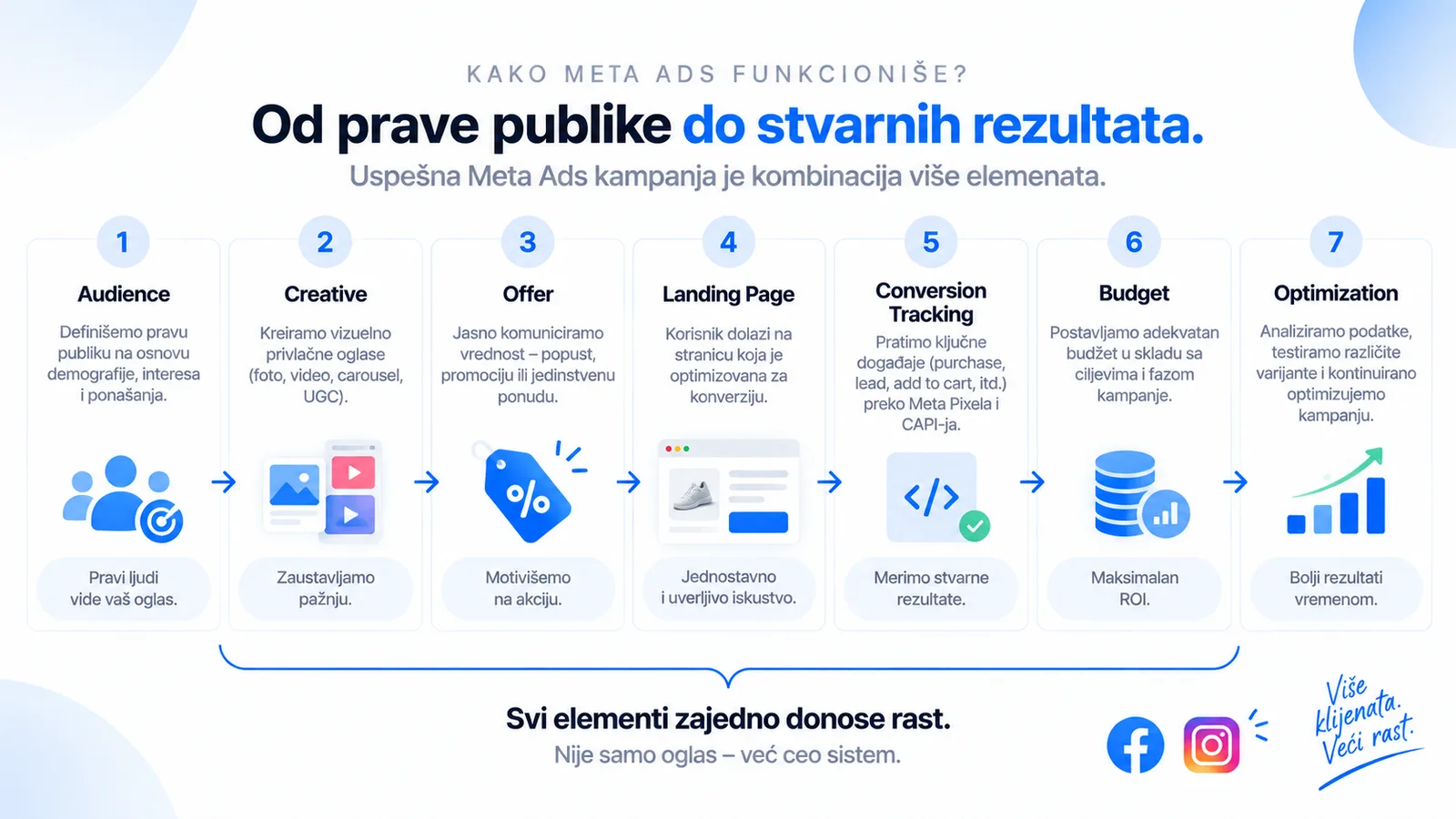
The result depends on a combination of factors: Audience + Creative + Offer + Landing Page + Conversion Tracking + Budget + Optimization.
If the audience is well defined but the ad is weak, the campaign can perform poorly. If the ad is excellent but the landing page doesn't convert, the problem may be after the click. If everything is set up well but Meta receives the wrong conversion signals, the algorithm may optimize the campaign toward the wrong users.
That's why Meta Ads should be viewed as a whole system, not just as creating ads.
Facebook and Instagram ads
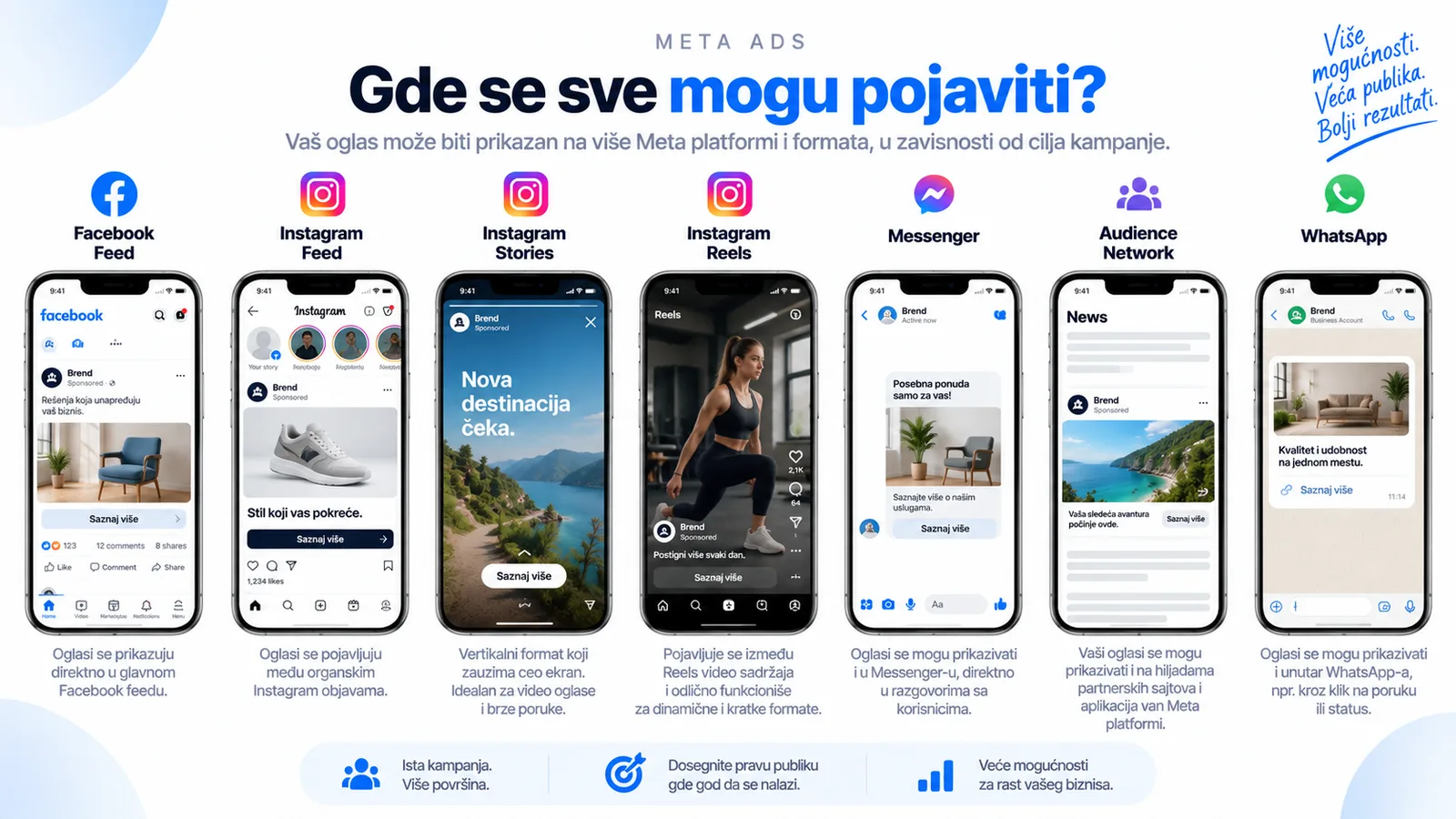
Meta lets you advertise in different places across its ecosystem.
- Facebook Feed — ads appear in the main Facebook feed.
- Instagram Feed — ads appear among organic Instagram posts.
- Instagram Stories — a full-screen vertical format that is especially well suited to short video ads and direct messages.
- Instagram Reels — a video format that has become one of the key ways people consume content on Instagram.
- Messenger and other surfaces — depending on the campaign and available options, ads can also appear on other Meta surfaces.
What goals can we achieve with Meta Ads campaigns?
Meta campaigns can have different goals, and the choice of goal should match the business goal.
For example, an e-commerce company will most often care about sales, while a local service business may care more about leads or calls.
Common goals include Sales, Leads, Traffic, Engagement, Awareness, and App promotion.
Choosing the goal matters because Meta uses that information to try to find users who are more likely to take the desired action.
Meta Ads for e-commerce
Meta Ads is especially interesting for online stores because products can be presented through visual content.
E-commerce campaigns can use product images, video demonstrations, UGC, testimonials, lifestyle creatives, promotions, bundle offers, carousel ads, and dynamic product ads.
The goal isn't just to bring a user to the site. The goal is for the user to buy the product.
That's why a properly configured Purchase event is very important.
What is the Meta Pixel?
The Meta Pixel is a tool that lets companies track certain user activities on their website and connect them with Meta advertising.
Events such as PageView, ViewContent, AddToCart, InitiateCheckout, Purchase, and Lead can be tracked.
These events can help measure campaign results and build audiences.
For example, you can create an audience of people who viewed a product but didn't buy, and then show them a remarketing ad.
Conversions API (CAPI)
Besides the Meta Pixel, there is also the Conversions API, which lets you send certain event data from your server to Meta.
CAPI can be part of a higher-quality tracking infrastructure and can be used together with the Pixel.
The goal is for Meta to receive better event data and to reduce dependence on browser-side tracking alone.
For more serious performance campaigns, especially when measuring sales matters, tracking infrastructure should be a priority.
Why is conversion tracking so important?
If a Meta campaign generates 100 leads, that may look like a great result at first glance. But after phone calls, it may turn out that a large share of those leads are low quality.
If Meta only receives the signal "100 leads," it doesn't have the same view of quality that your sales team has.
That's why, in lead generation campaigns, it's especially important to think about lead quality, not just quantity.

Meta Lead Ads
Meta lets companies run Lead Ads campaigns with forms that users can fill out directly inside the Meta platform.
This can reduce friction in the lead generation process.
A lead form can include questions that help qualify a potential client, for example "What is your monthly advertising budget?" or "Which service do you want to promote?"
This is especially useful when you want to optimize not just for the quantity of leads, but for their relevance.
How do you qualify leads?
Cost per lead isn't a sufficient metric.
Campaign A can generate 100 leads at €5 each, while Campaign B generates 30 leads at €15 each. If most leads from the first campaign are low quality and the second campaign generates real prospects, the second campaign can have greater business value.
That's why it's useful to track: Lead → Qualified Lead → Sales Opportunity → Customer.
This way, marketing and sales can work with the same data.
Meta Ads audiences
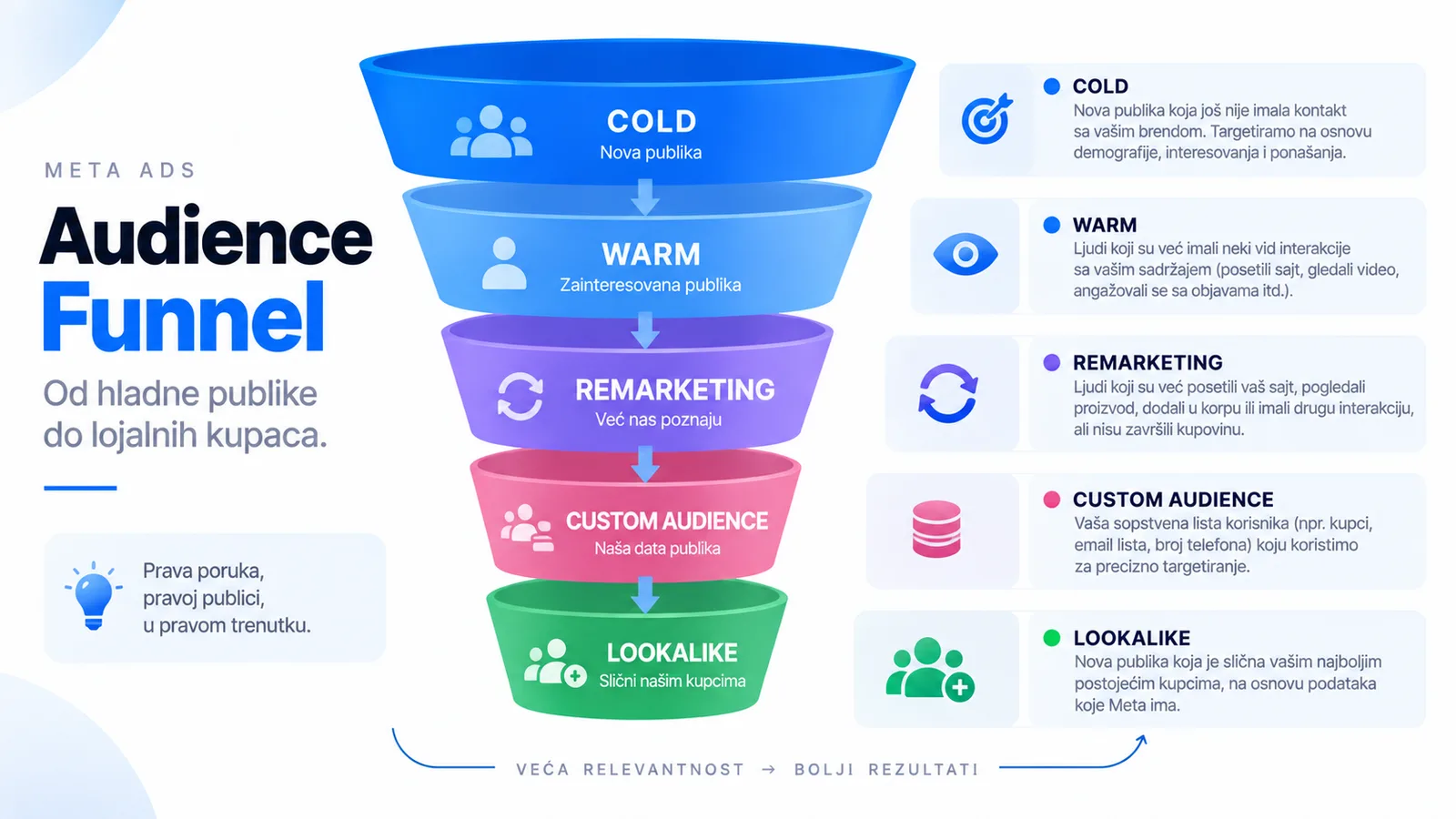
One of the big advantages of Meta advertising is the ability to work with different types of audiences.
- Cold audience — people who haven't yet had direct interaction with your brand.
- Warm audience — people who have already shown some interest, for example visited the site, watched a video, interacted with your Instagram profile, or clicked an ad.
- Remarketing audience — people who have already been in contact with your brand and whom you want to reach again.
- Custom Audiences — audiences created from available data and interactions, in line with Meta's rules.
- Lookalike Audiences — audiences Meta creates based on the characteristics of a specific existing audience.
Advantage+ and automation
Meta is using more and more automation in advertising.
Advantage+ solutions let Meta use its own automation systems for different parts of a campaign, including audience, placements, and optimization, depending on the campaign type.
This means modern Meta advertising isn't based solely on manually picking dozens of interests.
The quality of conversion signals, creatives, and data becomes increasingly important.
That's why it's very important that Meta receives the most precise information possible about what success means for your business.
How much does Meta advertising cost?
There is no universal price for Meta ads.
Cost depends on the market, competition, target audience, ad quality, campaign goal, placement, season, offer, and landing page quality.
Some campaigns can have a very low CPC but few conversions. Others can have a more expensive click but far more quality customers.
That's why it's not a good idea to judge a campaign only by cost per click.
What is CPM?
CPM (Cost Per Mille) is the cost per 1,000 impressions.
For example, if a campaign has a CPM of €5, the average cost for 1,000 ad views is €5.
CPM can be useful for understanding the cost of reaching an audience, but on its own it doesn't tell you whether a campaign is profitable.
What is CTR?
CTR (Click-Through Rate) shows the percentage of people who clicked an ad after seeing it.
If an ad gets 10,000 impressions and 500 clicks, its CTR is 5%.
CTR can help gauge how much an ad attracts attention and how relevant it is to the audience. However, a high CTR doesn't automatically mean a high number of sales.
What is CPC?
CPC (Cost Per Click) shows the average cost of a single click.
If you spend €100 and get 200 clicks, your CPC is €0.50.
But a cheap click isn't necessarily a good click. If 200 people click and nobody buys, the campaign hasn't achieved its business goal.
What is CPA / CPL?
For campaigns that generate conversions, CPA — Cost Per Acquisition — is often tracked, meaning how much it costs to achieve a given acquisition.
For lead generation campaigns, CPL — Cost Per Lead — is often used.
For example, €300 in spend and 20 leads gives a CPL of €15.
But the real KPI may be cost per qualified lead, not just cost per lead.
What is ROAS?
For e-commerce campaigns, one of the most important metrics can be ROAS — Return on Ad Spend.
If you spend €1,000 on Meta Ads and generate €4,000 in revenue, your ROAS is 4x.
But as with Google Ads, ROAS isn't the same as profit. You need to take into account product cost, margin, shipping, discounts, operating costs, returns, and other business expenses.
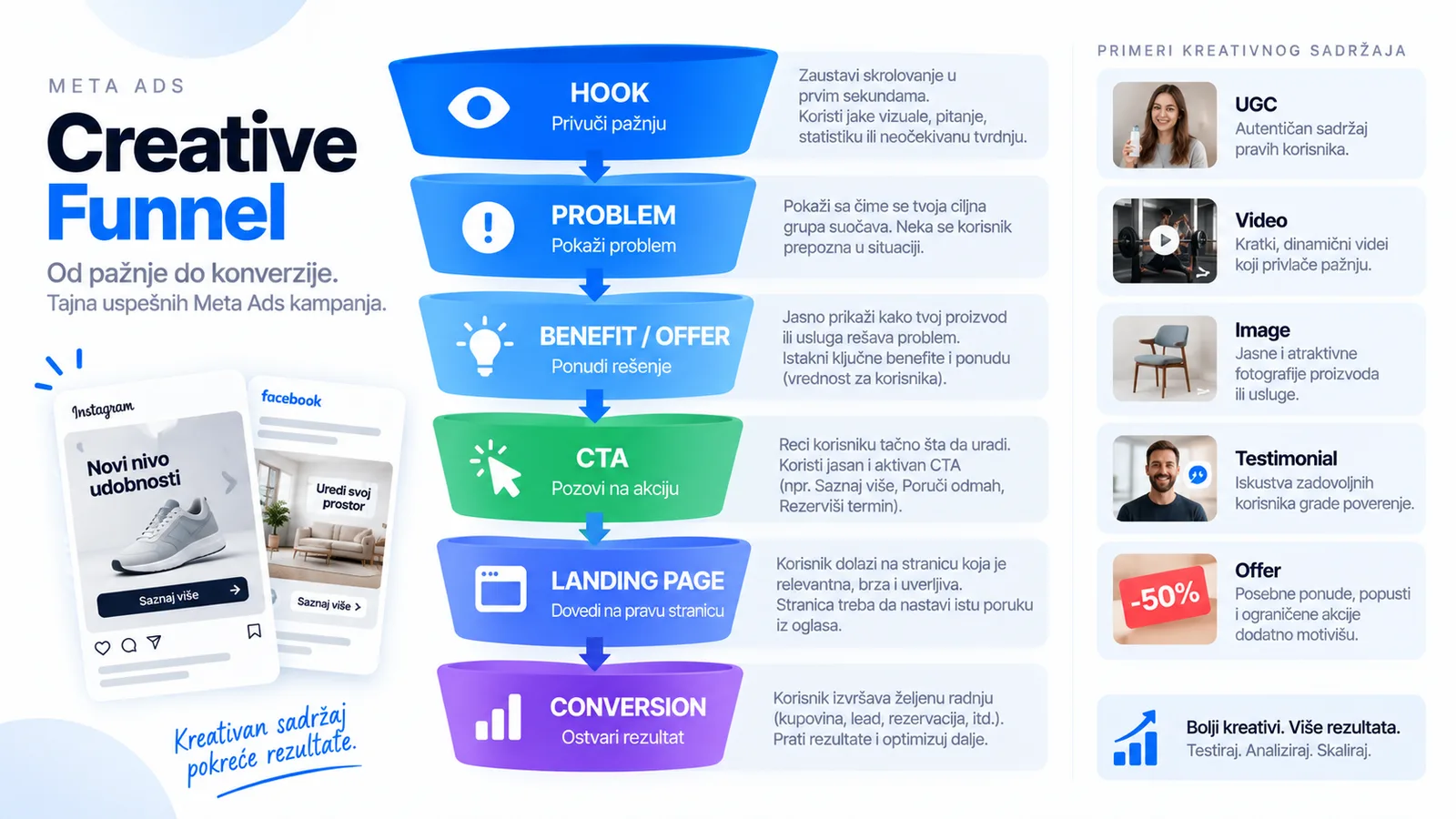
Creative is one of the most important elements of a Meta Ads campaign
With Meta ads, users usually don't arrive with the intent to search for something. The ad has to interrupt the scroll and capture attention.
A good Meta creative can include a strong hook, a clear problem, a product demonstration, a benefit, social proof, UGC, a testimonial, an offer, and a clear CTA.
The goal isn't just to make a nice design. The goal is to create a creative concept that attracts the right audience and leads it toward the desired action.
Why should you test multiple creatives?
There's no guarantee that any one ad will be the best.
That's why testing is one of the important parts of a Meta Ads strategy.
We can test different hooks, video vs. image, UGC vs. branded creative, different offers, CTA messages, products, formats, and landing pages.
Based on the results, we can decide which elements to develop further.
Remarketing: how to win back interested users
Many users won't buy on their first visit to a site.
That's why remarketing can be an important part of a strategy.
A user may first see an ad, visit the site, look at a product, and not buy. Later they may see a remarketing ad, return to the site, and complete the purchase.
Remarketing can be especially useful for products or services where users need more time to make a decision.
Meta Ads and the landing page
A good ad can't fully make up for a bad landing page.
If an ad promises 20% off the first order and the user doesn't see a clear offer on the page, they may leave the site.
That's why Ad → Landing Page → Offer → CTA should be aligned.
For e-commerce in particular, pay attention to price, availability, photos, benefits, reviews, shipping, payment methods, and checkout.
Meta Ads for different types of business
- E-commerce — Sales campaigns, product ads, remarketing, and creative testing.
- Local services — Lead generation, calls, messages, and remarketing.
- Beauty and wellness — Visual content, UGC, offers, testimonials, and lead generation.
- Fitness — Transformations, educational video content, lead forms, and remarketing.
- B2B — Awareness, remarketing, lead generation, and testing different messages for the target audience.
- Brands — Awareness, video, engagement, community building, and long-term remarketing.
Meta Ads for small businesses
Meta Ads isn't reserved for large companies only.
A small business can start with a relatively simple campaign structure, focusing on one product, one service, or one target audience.
More important than having many campaigns is having a clear goal, a good offer, a quality creative, properly set up tracking, enough data for optimization, and realistic expectations.
With a limited budget, it's often better to test a small number of clear hypotheses than to spread the budget across many campaigns and audiences.
The most common mistakes in Meta Ads advertising
- Boosting posts instead of strategic advertising.
- Too many interests and an overcomplicated audience.
- A single creative.
- Optimizing for the wrong goal.
- Poor tracking.
- Focusing only on CPL or CPC.
- Ignoring the landing page.
What does a good Meta Ads strategy look like?
A good Meta Ads strategy can be viewed through a few steps:
- Define the goal — Sales, Leads, Calls, or Awareness.
- Define the ideal customer.
- The offer — why would a user react right now?
- Creative strategy — which messages, formats, and angles do we want to test?
- Tracking — are we properly tracking what matters to us?
- Campaign — set up the appropriate structure and budget.
- Testing — test creatives, messages, audiences, and offers.
- Optimization — analyze the data and redistribute budget toward what delivers better results.
- Scaling — once we find what works, we can gradually increase investment.
How do you measure the success of a Meta Ads campaign?
The right KPI depends on the business goal.
- For e-commerce: Purchases, Revenue, ROAS, CAC, Conversion Rate, AOV, and Repeat Purchase Rate.
- For lead generation: Leads, CPL, Qualified Leads, Cost per Qualified Lead, Sales Opportunities, Customers, and CAC.
- For awareness: Reach, Impressions, CPM, Video Views, Frequency, and Brand metrics.
The most important thing is to connect marketing metrics to business results.
Meta Ads or Google Ads?
Google and Meta don't have to be competing channels.
Google Ads can catch a user who is already actively looking for a product or service. Meta Ads can introduce a product to a user who hasn't yet been actively searching for a solution.
That's why a combination can be very useful, with each channel playing its own role in the funnel.
The right choice depends on how customers find your product, how long the decision process takes, and what the economics of your business look like.
Conclusion
Meta Ads is far more than advertising on Instagram and Facebook.
A successful Meta campaign requires a combination of strategy, a quality offer, creative content, the right audience, tracking, testing, and optimization.
Most importantly, a campaign shouldn't be judged only by clicks, impressions, or leads.
The real question is: does Meta Ads bring in quality customers, and is acquiring them profitable?
When tracking and strategy are set up properly, Meta Ads can be a powerful channel for sales, lead generation, remarketing, and brand building.
Want to find out if Meta Ads makes sense for your business?
At Tyne Agency, we approach Meta advertising through performance marketing — from strategy and campaign creation to the Meta Pixel, the Conversions API, creative testing, optimization, and business results analysis.
We don't focus only on how many people saw or clicked an ad. The focus is on how many quality customers or clients a campaign can bring in, and how that result can be scaled further.
Book a consultation and find out how Meta Ads can fit into your marketing system.