
Google Ads or Meta Ads? This is one of the most common questions business owners ask when they want to invest money in online advertising.
The answer isn't simple — there's no universally better channel. Google Ads and Meta Ads work on different principles and can play completely different roles in a marketing strategy.
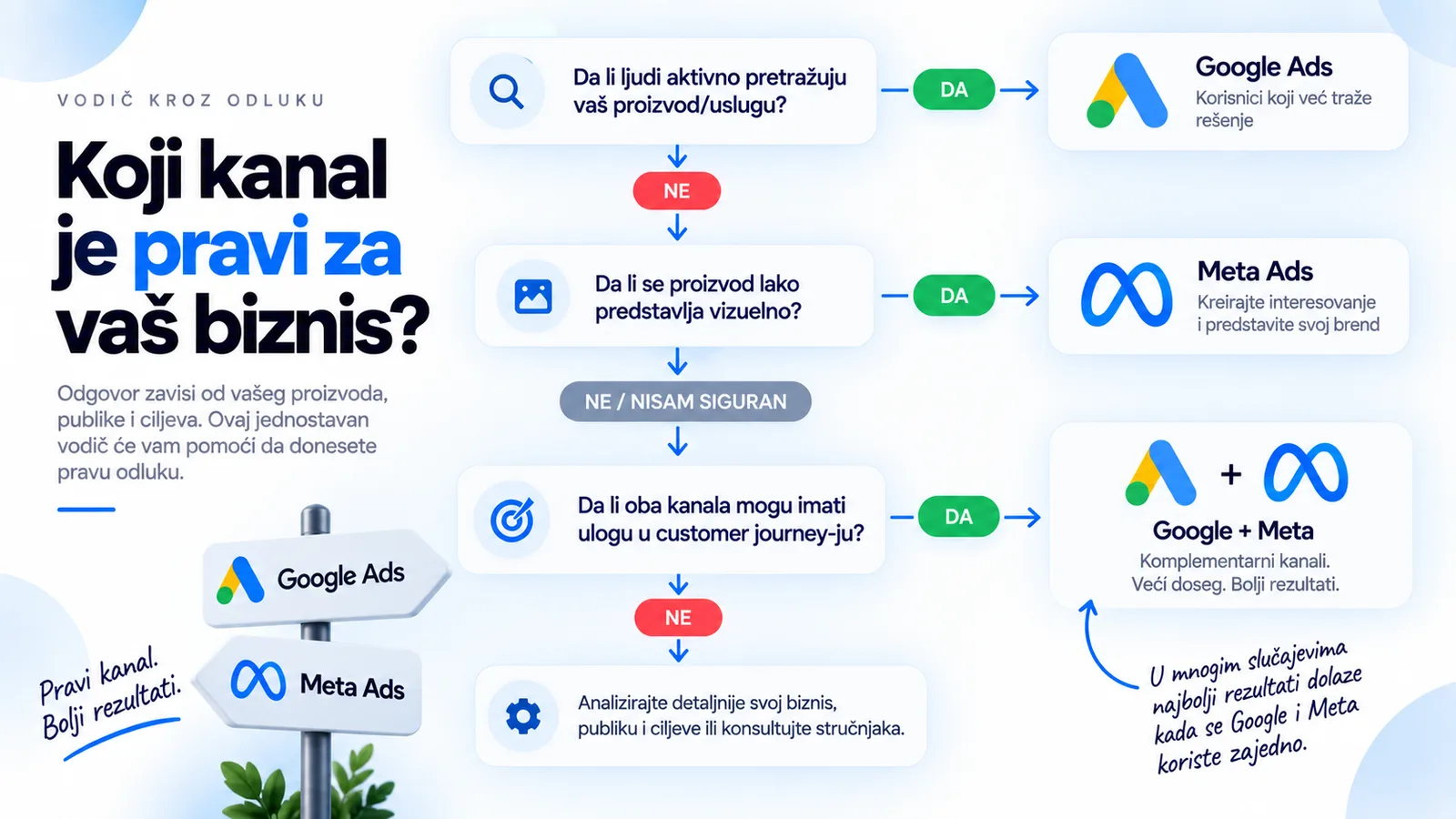
Google most often catches users who already have a need and are actively searching for a solution, while Meta lets you introduce a product or service to people who may not yet be actively looking for what you offer.
That's why the right choice depends on your product or service, target audience, sales process, budget, and campaign goal.
Below we explain the differences between Google Ads and Meta Ads advertising, when each channel makes the most sense, and how to assess what fits your business.
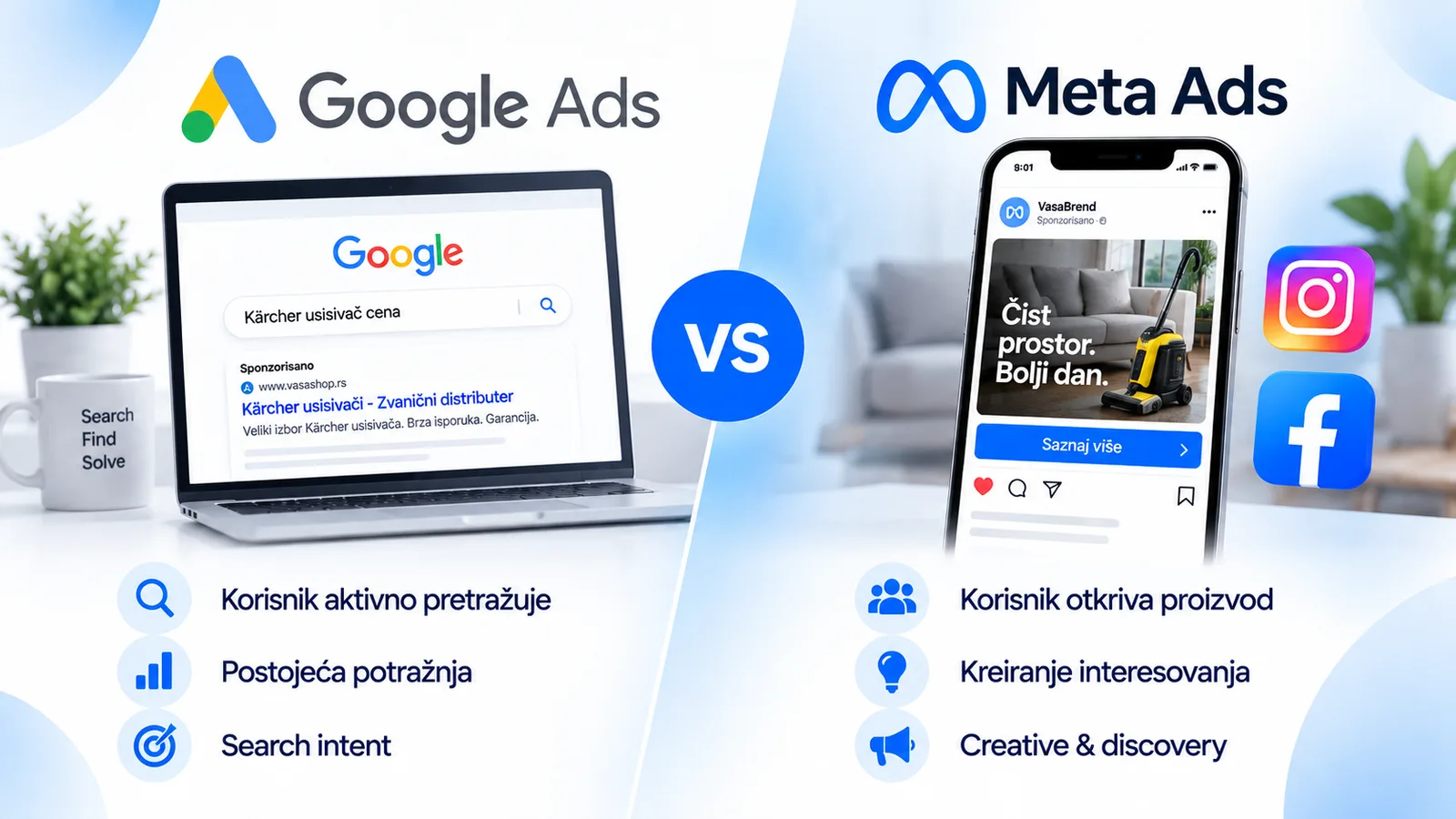
Google Ads: Advertising when the user is already looking for a solution
Google Ads is especially interesting when people already use Google to find the product or service they want.
For example, someone who needs a plumber might search:
- "plumber near me"
- "emergency plumber"
- "plumber London"
Someone who wants to buy a specific product might search:
- "Kärcher vacuum price"
- "floor washing machine"
- "garden tools price"
In these situations, the user is already showing a certain level of purchase intent.
Google Ads lets a business appear at the exact moment a potential customer is looking for what the company offers.
When can Google Ads make particular sense?
- local services
- e-commerce stores
- professional services
- B2B services with clear search intent
- travel and transport services
- certain health and aesthetic services, in line with advertising rules
- products and services people actively search for
One of the biggest advantages of Google Ads is precisely this search intent.
A user searching "estate lawyer near me" is in a completely different stage of the process than someone who simply sees an Instagram ad for a law firm.
Meta Ads: When you want to reach potential customers
Meta Ads — advertising on Facebook and Instagram — works differently.
Users usually don't open Instagram because they want to buy a specific product. They opened the app to look at content, communicate, or do something else.
That's why Meta can be especially useful when you need to: capture attention → introduce a product/service → build interest → drive action.
For example, a cosmetics brand can use video to show a product, results of use, application method, or customer experience.
A restaurant can showcase new dishes.
A fitness business can show transformations and workouts.
An e-commerce brand can test different products, offers, and creative formats.
When can Meta Ads be a good choice?
Meta is especially interesting for businesses where visual presentation, creative content, and audience interest play a big role.
- beauty and cosmetics
- fashion
- fitness
- restaurants and food
- lifestyle products
- e-commerce
- education and courses
- certain local services
- brands that want to build recognition
A big advantage of Meta is the ability to test different creatives, messages, offers, and formats.
Google Ads vs Meta Ads — the key difference
The simplest way to present the difference:
| Google Ads | Meta Ads |
|---|---|
| Captures existing demand | Creates and builds interest |
| User is actively searching | User discovers a product/service |
| Search intent is very important | Creative and messaging are very important |
| Text ads are key on Search | Video, images, and UGC play a big role |
| Great for high-intent searches | Great for discovery and demand generation |
| Search, Shopping, Performance Max, etc. | Facebook, Instagram, and various Meta formats |
| Can be very effective for local services | Can be very effective for visual products |
However, this isn't a strict divide.
Google Ads can build demand through certain formats, and Meta Ads can generate direct sales and leads.
That's why a channel should be viewed in the context of the specific business, rather than through the simple rule "Google is for sales, Meta is for awareness."
What's better for e-commerce?
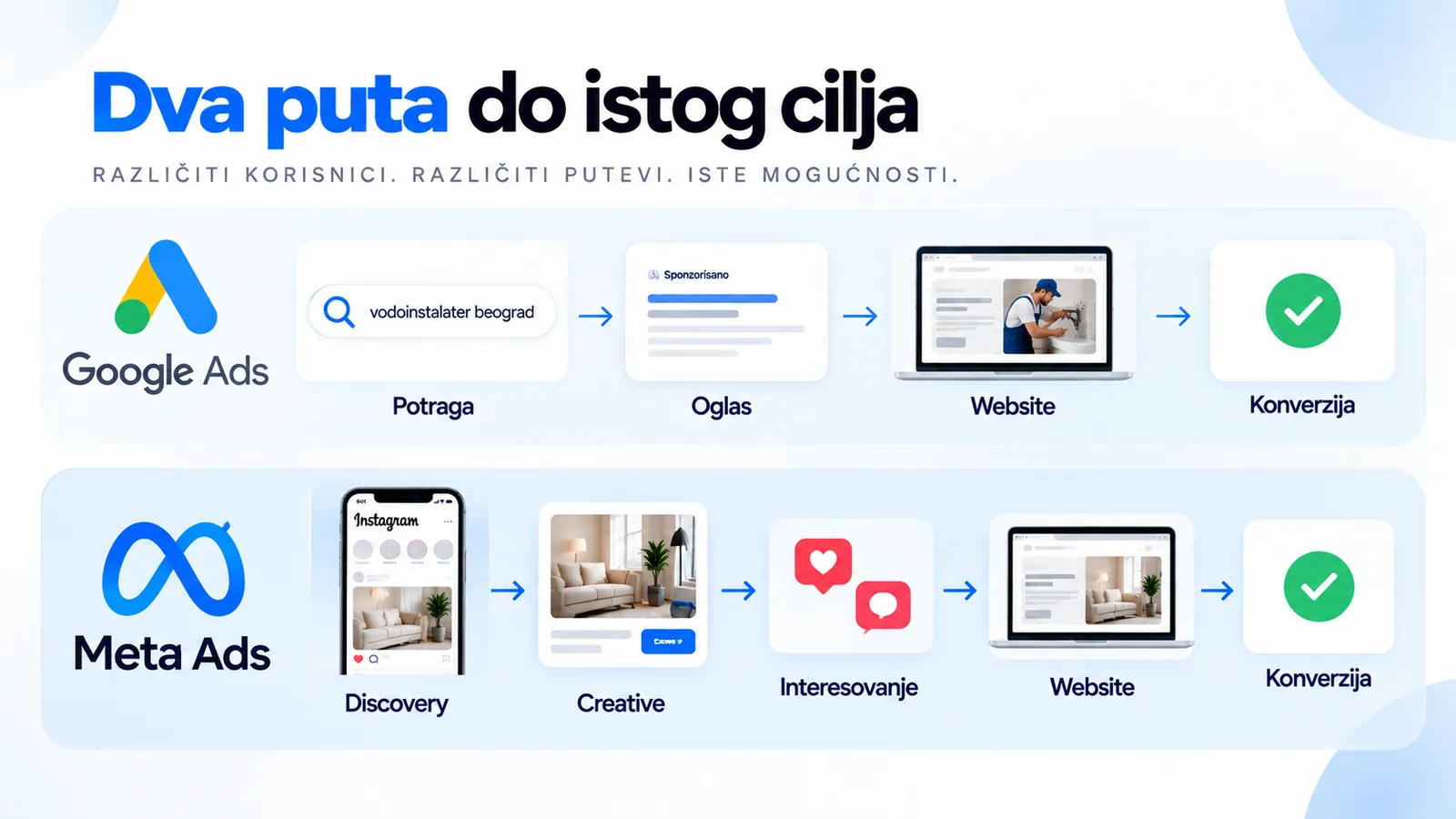
For online stores, both channels often make sense, but for different reasons.
Say you sell home appliances. On Google, you can target people who are already searching for specific products, categories, or models.
On Meta, you can present products through:
- video demonstrations
- UGC
- lifestyle photography
- promotions
- new products
- bundle offers
- remarketing
Google can catch a user who already knows what they want. Meta can introduce a product to someone who may not yet have thought about buying.
Because of that, the combination can create a broader customer journey.
What's better for a local business?
For local services, Google Ads often has a very clear advantage when there's enough relevant search volume.
"plumber near me", "auto repair shop", "dentist near me" — the user already has a specific need. Google Search lets your ad appear at the exact moment that need exists.
Meta, on the other hand, can be useful for:
- promoting a special offer
- building local recognition
- video content
- remarketing
- lead generation
That's why, for a local business, the choice shouldn't be based only on which platform is "more popular," but on how people actually arrive at a purchase decision.
And what's better for B2B?
For B2B businesses, the answer depends on the type of product and customer.
If people are actively searching for a specific solution, Google Search can be very relevant — for example "ERP software UK", "accounting software for businesses", or "B2B marketing agency".
Meta can play a different role — especially for awareness, educational content, remarketing, and re-engaging people who've already had contact with the brand.
That's why, in B2B, it's especially important to understand the length of the sales cycle.
If a potential client takes several weeks or months to decide, it's not enough to look only at the cost of a single lead.
Google Ads or Meta Ads by business type
The table below isn't a universal rule — it's a practical framework for an initial assessment:
| Business type | Possible primary channel | Possible secondary channel |
|---|---|---|
| Local services with clear demand | Google Ads | Meta Ads |
| E-commerce | Google Ads + Meta Ads | — |
| Beauty / cosmetics | Meta Ads | Google Ads |
| B2B services with clear search intent | Google Ads | Meta Ads |
| Restaurants / food | Meta Ads | Google Ads |
| Products that rely heavily on visual content | Meta Ads | Google Ads |
What if you have a limited budget?
This is a situation where you shouldn't automatically launch both platforms.
If your budget is limited, you should first answer a few questions:
1. Are people actively searching for what you sell?
If there's strong, relevant demand, Google Search can be a logical starting point.
2. Is the product something that's easy to present visually?
If so, Meta can play a significant role.
3. What's a new customer worth?
It's not the same if one new customer brings €50 or €5,000 in revenue.
4. What's your margin?
Revenue on its own isn't enough to assess a campaign's success.
5. Do customers buy again?
For products with repeat purchases, the value of a new customer can be significantly higher than just their first purchase.
Google Ads + Meta Ads: Why combine both?
In many cases, the question isn't "Google or Meta?" but "How can Google and Meta work together?"
One possible funnel looks like this:
Meta Ads → Potential customer discovers the brand → Visits the site → Remarketing → Searches for the brand/product on Google → Google Ads → Purchase
And the reverse works too.
A user might first come through Google, look at a product, not buy anything, and later see a Meta ad.
That's why it's important to look at the whole customer journey, not just the last click.
How do you know which channel is working?
Don't focus only on:
- number of clicks
- cost per click
- impressions
- reach
- engagement
For performance marketing, business results matter much more:
- number of purchases
- revenue
- number of quality leads
- CAC — customer acquisition cost
- ROAS
- conversion rate
- average order value
- repeat purchase rate
- customer lifetime value
For example, a campaign generating 100 leads isn't necessarily better than one generating 30 leads.
If 15 of those 30 leads became customers, while only 5 out of the 100 did, the cost or quantity of leads alone doesn't give the full picture.
That's why data quality and properly set up conversion tracking matter a great deal.
What do we recommend before launching a campaign?
Before spending your first euro, you should define:
1. The campaign goal
Sales, quality leads, calls, bookings, sign-ups, or store visits.
2. Your target audience
Who is the ideal customer?
3. The economics
What's a new customer worth to you, and how much can you afford to pay to acquire one?
4. Tracking
Purchases, leads, calls, forms, revenue, add to cart, checkout.
5. Budget
Budget should be tied to market size, competition, business economics, and goals — not set as an arbitrary number.
So, Google Ads or Meta Ads?
There's no single answer that applies to every business.
If your potential customer is actively searching for a product or service, Google Ads can be a natural channel for capturing existing demand.
If you need to capture attention, introduce a product, test creative messages, and build interest, Meta Ads can play an important role.
If you have enough budget and the right customer journey, Google and Meta can work together, with each channel playing its own role in the funnel.
Most importantly, the choice of platform shouldn't start with the question: "Which platform is better?"
but rather: "How do our potential customers find, consider, and buy our product or service?"
The answer to that question is often the best starting point for choosing a channel.
Want to find out which channel makes more sense for your business?
At Tyne Agency, we approach Google and Meta advertising through performance marketing — from strategy and campaign setup to tracking, optimization, and business results analysis.
If you're not sure whether your business should be on Google, Meta, or both platforms, we can analyze your product, target audience, competition, and budget, and define the right approach.
Book a consultation with Tyne Agency and find out which approach makes the most sense for your business.